

Between November 17 and November 23, 2026, three labs shipped language models that run some of their layers more than once per token: SenseTime’s SenseNova-Loop-9B, Thinking Machines’ Inkling 2 Mini, and Z.ai’s 750B-scale GLM-5.4. Two months earlier, reporting tied OpenAI’s GPT-6 Astra to the same trick. The idea had sat in papers since 2018. It reached production in about a quarter.

A looped transformer stores a block of layers once and applies it several times, feeding each pass’s hidden states into the next. You get the serial depth of a deep network from the checkpoint of a smaller one. You pay for it in compute per token, KV cache and training cost, and most of 2026’s research has gone into shrinking those bills.
Stored Layers vs Executed Layers
In a standard decoder, the layers you store and the layers you run match one to one: forty-eight on disk, forty-eight per token. A looped model breaks that.
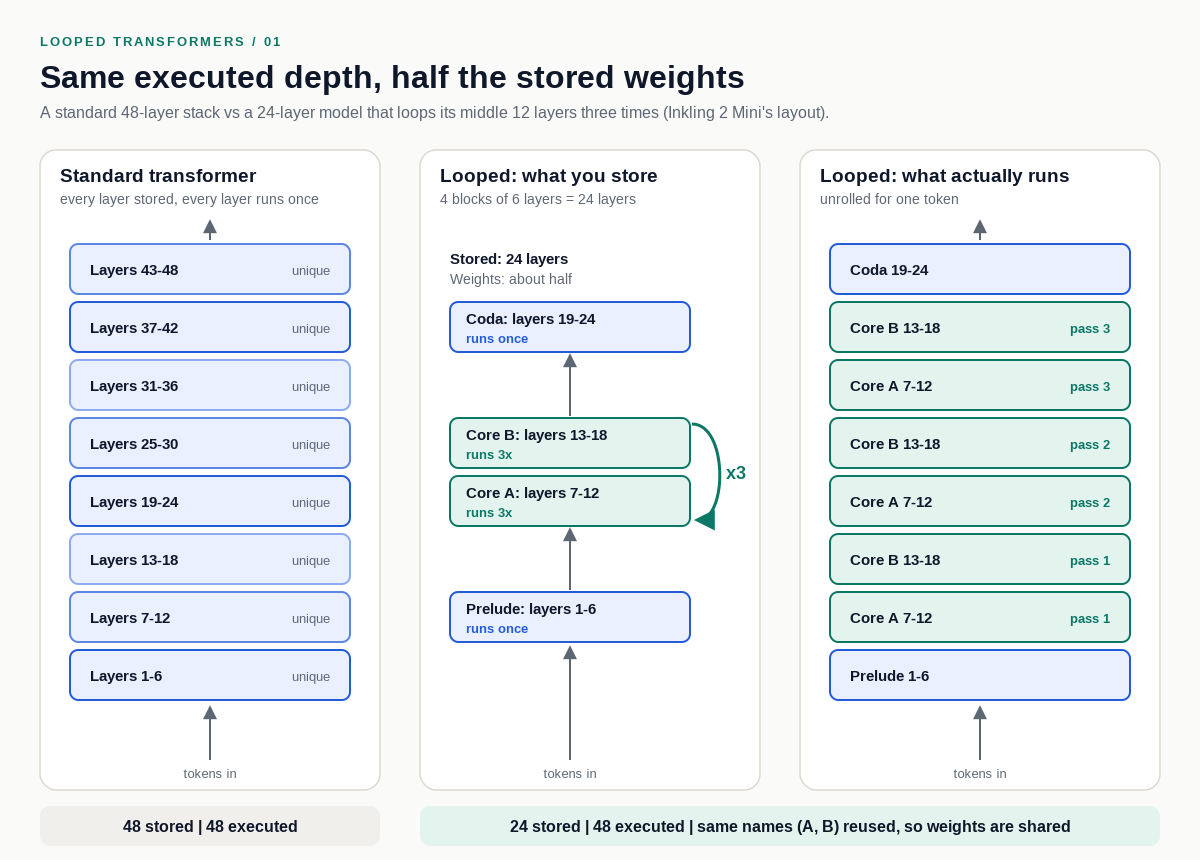
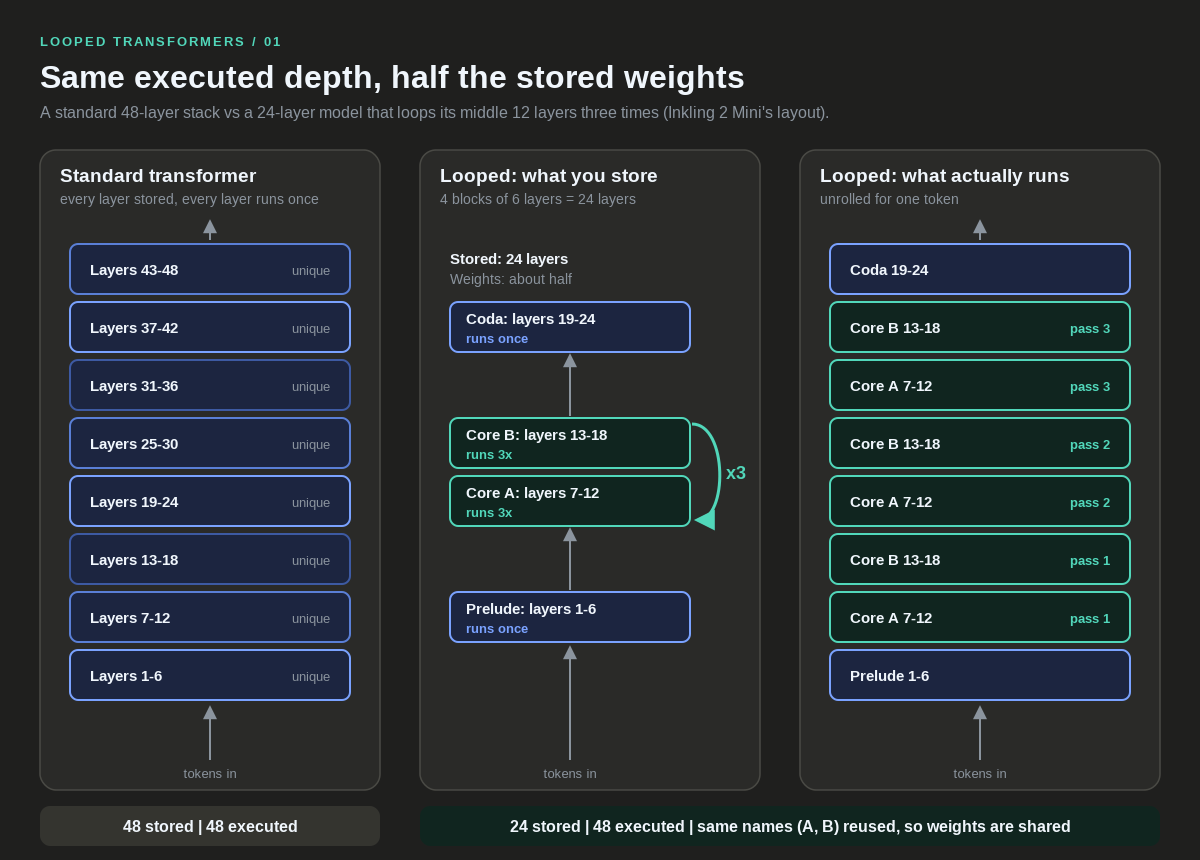
Most looped LMs share a three-part layout the recurrent-depth literature calls prelude, core, coda. The prelude $P$ runs once and maps tokens into a latent space. The core $R_\theta$ runs $R$ times with the same weights. The coda $C$ runs once and maps the final state to logits:
\[e = P(x), \qquad u_r = R_\theta\big(\mathrm{inject}(h_r, e)\big), \qquad h_{r+1} = h_r + g_r \odot (u_r - h_r), \qquad \hat{y} = C(h_R)\]Input re-injection mixes the prelude output $e$ back in at every pass, so the loop state stays anchored to the prompt as $R$ grows. NVIDIA’s Dory adds $e$ to the state and L2-normalizes before each core pass; Huginn and Parcae use variants.
Per-token gates $g_r \in [0, 1]$ decide how much of each pass gets written to the residual stream. Z.ai says GLM-5.4’s gates learned a division of labor on their own: a conservative first pass that builds global context, a second that refines, and bolder first-pass writes on hard tokens. Inkling 2 Mini starts its cross-pass “message” gated fully off, so each loop begins as a non-looped model and the gate opens during training.
Executed layers $= \lvert P \rvert + R \cdot \lvert R_\theta \rvert + \lvert C \rvert$; stored layers $= \lvert P \rvert + \lvert R_\theta \rvert + \lvert C \rvert$.
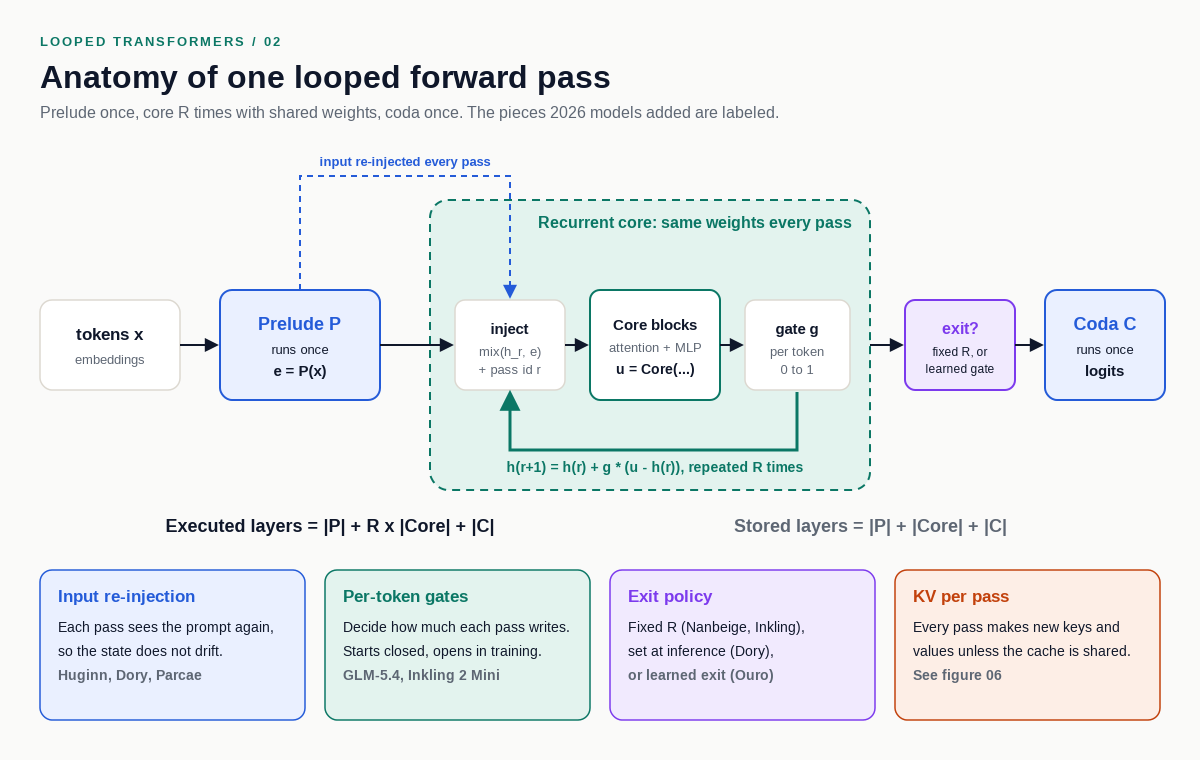
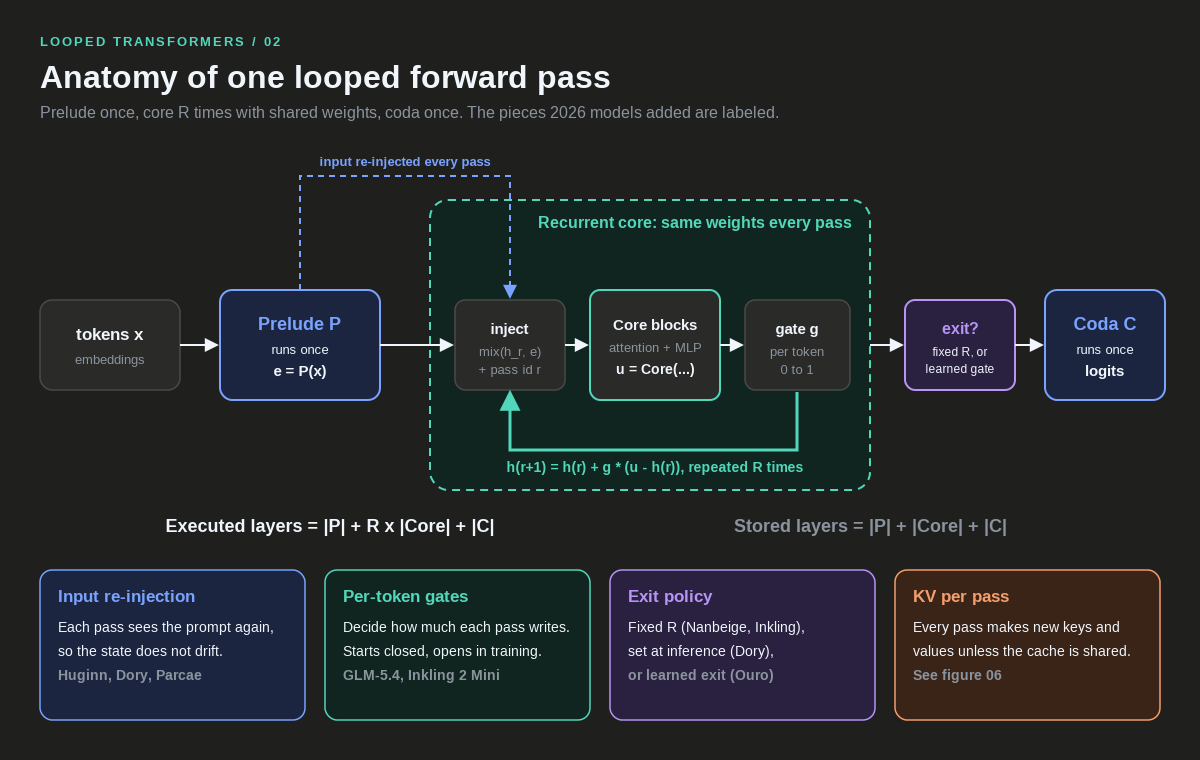
The last choice is the exit policy. Nanbeige 4.2 and Inkling 2 Mini fix the loop count. Dory lets you set it per request. Ouro trains an exit gate that stops early on easy tokens, and Mixture-of-Recursions routes each token to its own depth.
Three Ways to Spend Compute
To get a better answer you can make the model bigger, or let it write more. Reasoning models leaned on longer chains of thought, and agents turned that into a real bill: one agentic coding task can burn hundreds of thousands of tokens, each serialized through decode.
Looping adds a third knob: more depth per token. The model computes longer before committing to each token, so it can reach the same answer in fewer of them.
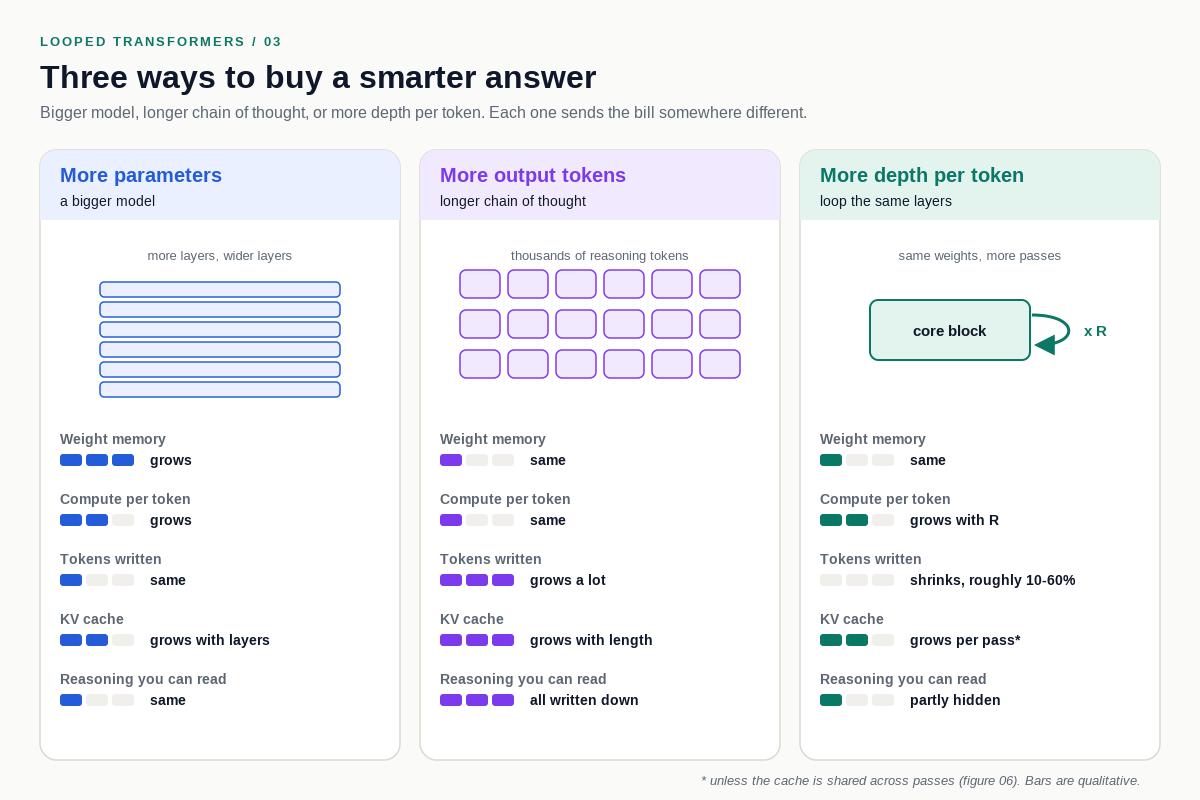
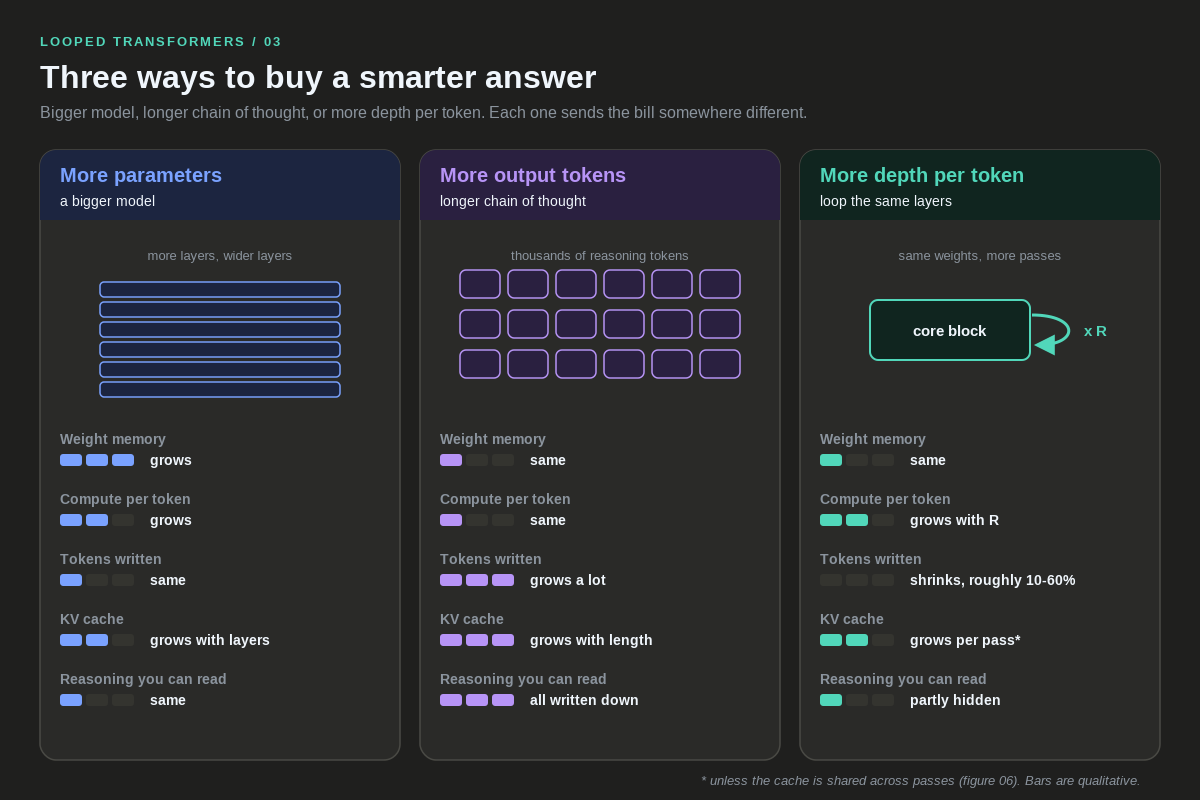
| Model | What changed with looping | Output-length effect |
|---|---|---|
| GLM-5.4 (30B ablation) | Same params, loop on vs off | 10-14% shorter outputs on GPQA-Diamond, MMLU-Pro and others |
| Inkling 2 Mini (research variant) | 1 pass vs 5 passes | GPQA Diamond reasoning drops from 3,703 to 1,661 tokens |
| Dory 1.0 4B | 1 loop vs 4 loops | 1.3x to 2.5x fewer generated tokens |
If your agent writes 40% fewer tokens, doubling the cost of a slice of the layers still leaves you cheaper per task.
A Short Lineage (2018 to 2025)
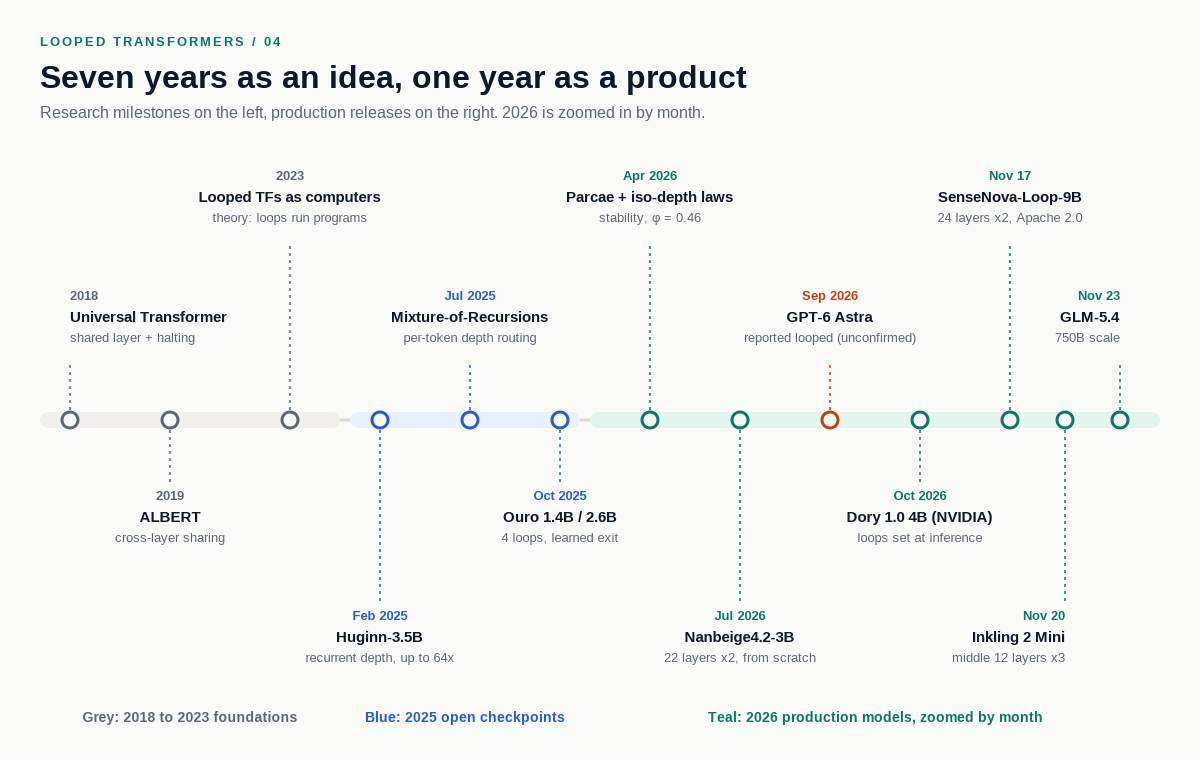
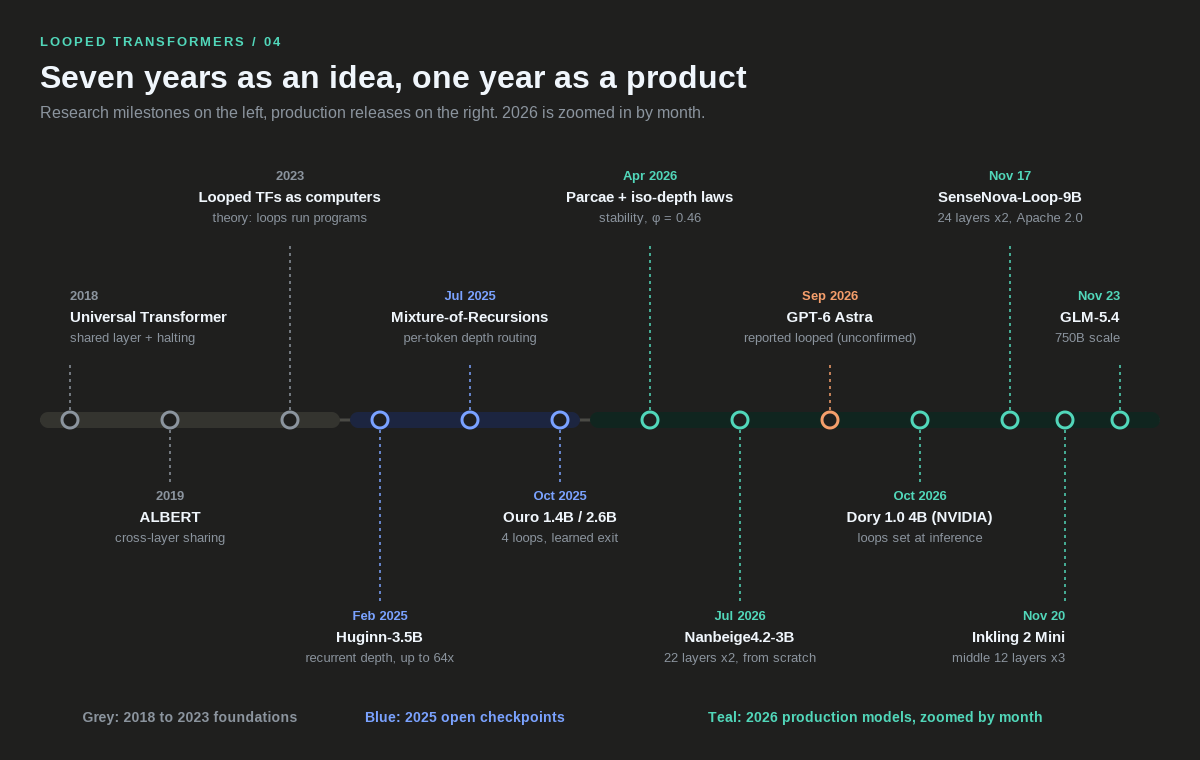
- Universal Transformer (2018) applied one shared layer repeatedly with per-position halting. ALBERT (2019) showed full cross-layer sharing works at BERT scale.
- Theory (2023 to 2025) showed looped transformers can act as programmable computers with a constant parameter count, and that a $k$-layer model looped $L$ times can nearly match a $kL$-layer model on reasoning (Reasoning with Latent Thoughts).
- Huginn-3.5B (Feb 2025) trained on 800B tokens with a randomly sampled loop count and kept improving up to about 64 iterations at test time.
- Mixture-of-Recursions (Jul 2025) gave each token its own recursion depth.
- Ouro (Oct 2025) from ByteDance Seed released 1.4B and 2.6B “LoopLMs” with four recurrent steps and a learned exit gate.
- At the tiny end, HRM and TRM solved puzzle benchmarks with a few million looped parameters.
The 2026 Model Wave
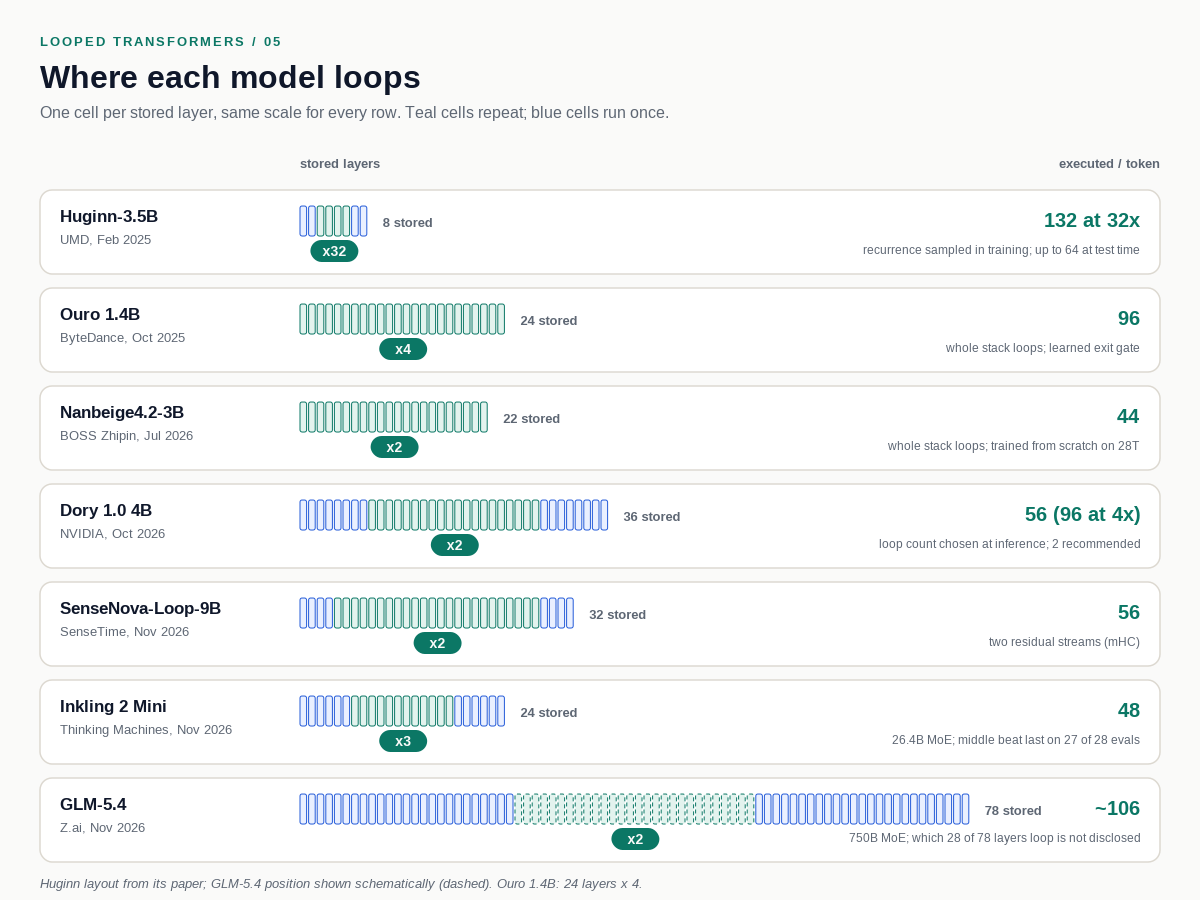
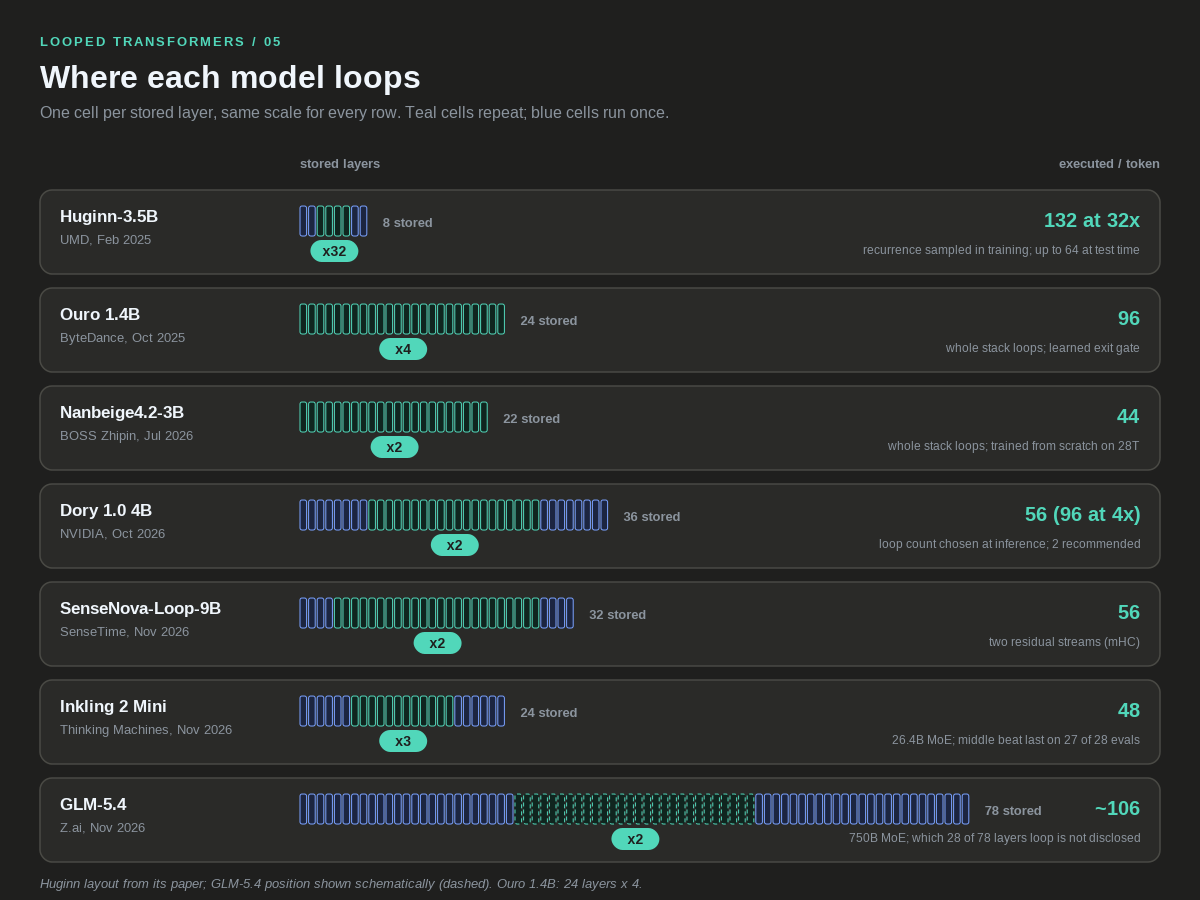
One cell per stored layer, teal for layers that repeat:
| Model | Org | Released | Params | Stored → executed | How it was made | Weights |
|---|---|---|---|---|---|---|
| Nanbeige4.2-3B | BOSS Zhipin | Jul 21, 2026 | 3B non-embedding | 22 → 44 (whole stack x2) | From scratch, 28T tokens | Apache 2.0 |
| Dory 1.0 4B | NVIDIA | Oct 16, 2026 | ~4B | 36 → 56 at x2 (96 at x4) | Looping added in last quarter of pretraining | Open |
| SenseNova-Loop-9B | SenseTime | Nov 17, 2026 | ~9B (~14.6B “inference params”) | 32 → 56 (layers 4-27 x2) | Preview Oct 30, full Nov 17 | Apache 2.0 |
| Inkling 2 Mini | Thinking Machines | Nov 20, 2026 | 26.4B total MoE, 3.4B active | 24 → 48 (middle 12 x3) | Expert pruning, distillation, RL | Open |
| GLM-5.4 | Z.ai | Nov 23, 2026 | 750B scale MoE | 28 layers run x2 | Converted from GLM-5 base by continued training | Planned |
| GPT-6 Astra | OpenAI | Sep 3, 2026 | Undisclosed | Undisclosed | Reported, never confirmed | No |
GLM-5.4: the first openly looped flagship
Z.ai calls GLM-5.4 its first flagship built on a Loop Transformer. It runs 28 layers of the GLM-5 base twice per forward pass; by one outlet’s count that is 28 of 78 layers, about 36% more depth for zero new parameters.
Z.ai did not pretrain a looped model. It converted the trained GLM-5 base through continued training, arguing that looped models trained from scratch still trail standard ones at equal pretraining compute, and validated the recipe at 1B, 4B, 30B and 750B. In the 30B iso-parameter ablation, looping cost about 10% more training compute, helped most on math, science and long context, and cut average output length 10-14%. For serving, the second pass reuses the sparse KV entries and attention indices from the first and keeps fresh KV only in a local sliding window, so the extra cost is one window instead of a second full-context cache.
Z.ai claims intelligence “comparable to 2T-3T parameter models” but hasn’t published flagship benchmarks, and it warns the model can fall into long “marathon thinking” loops. It is live on the GLM Coding Plan, with API access and open weights promised after safety hardening.
Inkling 2 Mini: the best public ablations
The Inkling 2 Mini release post is the best single source on looped models this year. The model has 24 layers in four blocks of six. The outer blocks run once; the two middle blocks run three times. Each later pass also reads the previous pass’s middle-block output, and every layer uses attention residuals to learn its own mix of earlier block outputs.
- Where to loop. Looping the middle 12 layers beat looping the last 12 on 27 of 28 evaluations, with compute-equivalent gains of 1.51-1.91x vs 1.24-1.36x. The first and last layers mostly translate between token embeddings and internal representations; the middle does the abstract work.
- Is it worth it. A non-looped twin used 7.5% less training compute but needed 140% more inference compute to match the looped model’s loss on 512k-token agentic traces.
- How many loops. On a variable-loop research model, the no-CoT time horizon rose from 16 seconds at one pass to 37 at three, then plateaued. Multi-hop lookup kept improving up to ten passes, so the ceiling depends on how serial the task is.
The 26.4B MoE fits in about 20GB, scores 79.2% on SWE-bench Verified, and runs on a 32GB Mac. Goodfire’s interpretability work found layers that read from earlier and “future” versions of themselves across loops.
SenseNova-Loop-9B: looping in a small multimodal model
SenseTime’s model has 32 decoder layers and runs layers 4 through 27 twice, for 56 layers of compute per forward pass. It takes text and images, uses two residual streams (manifold-constrained hyper-connections), and ships under Apache 2.0. SenseTime claims parity with Qwen3.8-27B on selected agent and data-analysis benchmarks; the official 4-bit build is about 4.9 GB. Adaptive iteration counts are on the roadmap.
Dory 1.0 4B: loops as a runtime dial
NVIDIA’s Dory has 8 input layers, a 20-layer shared core and 8 output layers, on a normalized-GPT backbone pretrained in NVFP4. You choose the loop count at serving time (2 recommended), so one resident checkpoint serves as a fast model or a slower, stronger one. Dory trained without loops for the first three quarters of pretraining. NVIDIA reports a KV footprint equal to a non-looped model at any loop count, and four loops generate 1.3-2.5x fewer tokens than one.
Nanbeige4.2-3B: the from-scratch counterexample
Nanbeige4.2-3B runs its whole 22-layer stack twice, with no routing and no exit. BOSS Zhipin pretrained it from scratch on 28T tokens, and its technical report found that from scratch beat upcycling a standard model by a wide margin, the opposite of what Z.ai and NVIDIA concluded. Going past two passes gave marginal gains and slowed and destabilized training.
GPT-6 Astra: the one nobody confirmed
Shortly before launch, The Information reported that OpenAI’s new flagship used “recurrent depth,” and coverage has repeated it as fact since. OpenAI’s system card and launch material never mention looping. OpenAI did disclose that its own evaluations found Astra’s written reasoning harder to monitor than its predecessor’s, and that the model controlled its own chain of thought better. Nobody outside OpenAI knows whether looping, training or both caused that.
The Monitorability Question
Chain of thought lets you read what a reasoning model is doing. Looping moves some of that reasoning into hidden states you can’t read.
- Inkling 2 Mini (26B): CoT gets shorter with more passes but stays legible. Stealth attack rates on LinuxArena showed no clear trend with loop count, and Thinking Machines reports no meaningful monitorability drop at this scale, while cautioning that bigger or more latent architectures may differ.
- GPT-6 Astra (frontier): OpenAI’s tests found monitorability got worse.
My read: two or three loops over a middle block won’t hide a plan from a monitor. The trajectory worries me more. Each lab that adds loops trades legible tokens for illegible depth, and the economics push in one direction.
What Looping Costs
A loop is worth about half a layer
Iso-depth scaling laws give the cleanest measurement. The authors ran 116 pretraining runs at $r \in \lbrace 1, 2, 4, 8 \rbrace$ with effective depth held fixed and fit:
\[L = E + A\left(N_\text{once} + r^{\varphi} N_\text{rec}\right)^{-\alpha} + B D^{-\beta}\]The recurrence-equivalence exponent $\varphi$ is 1 if looping a block $r$ times equals $r$ unique blocks, and 0 if extra passes add nothing. They measured $\varphi = 0.46$.
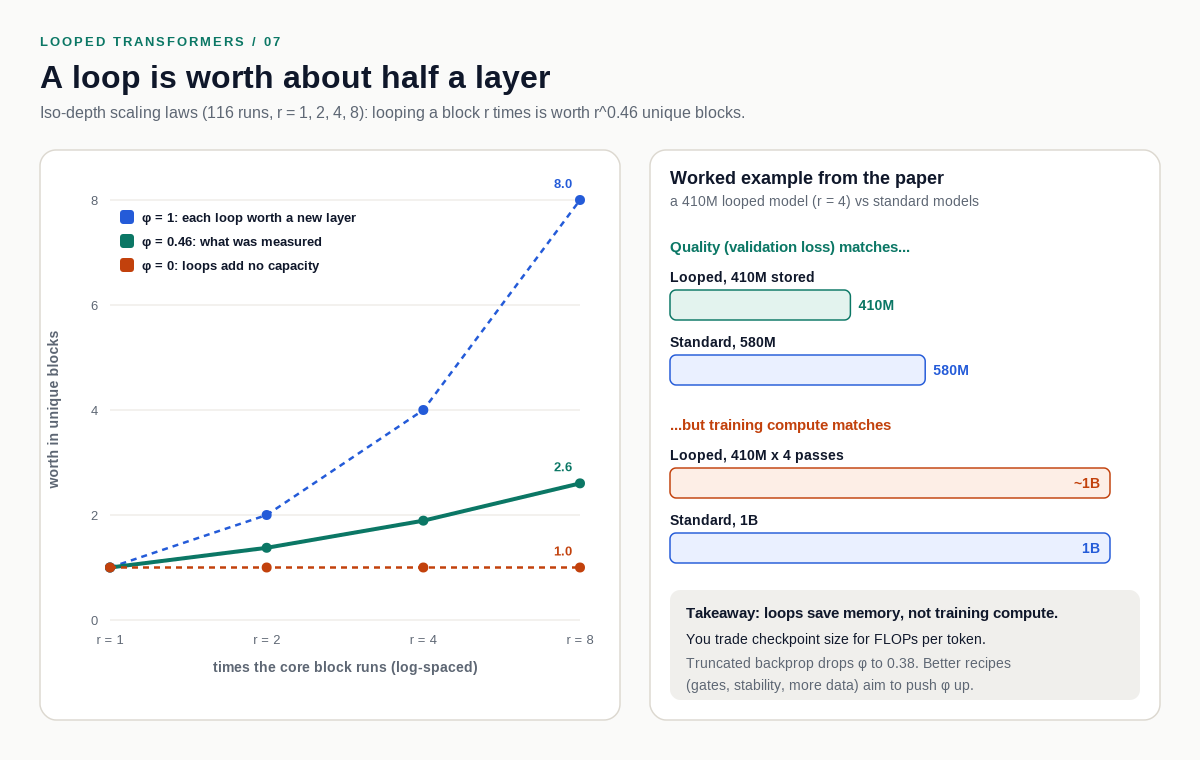
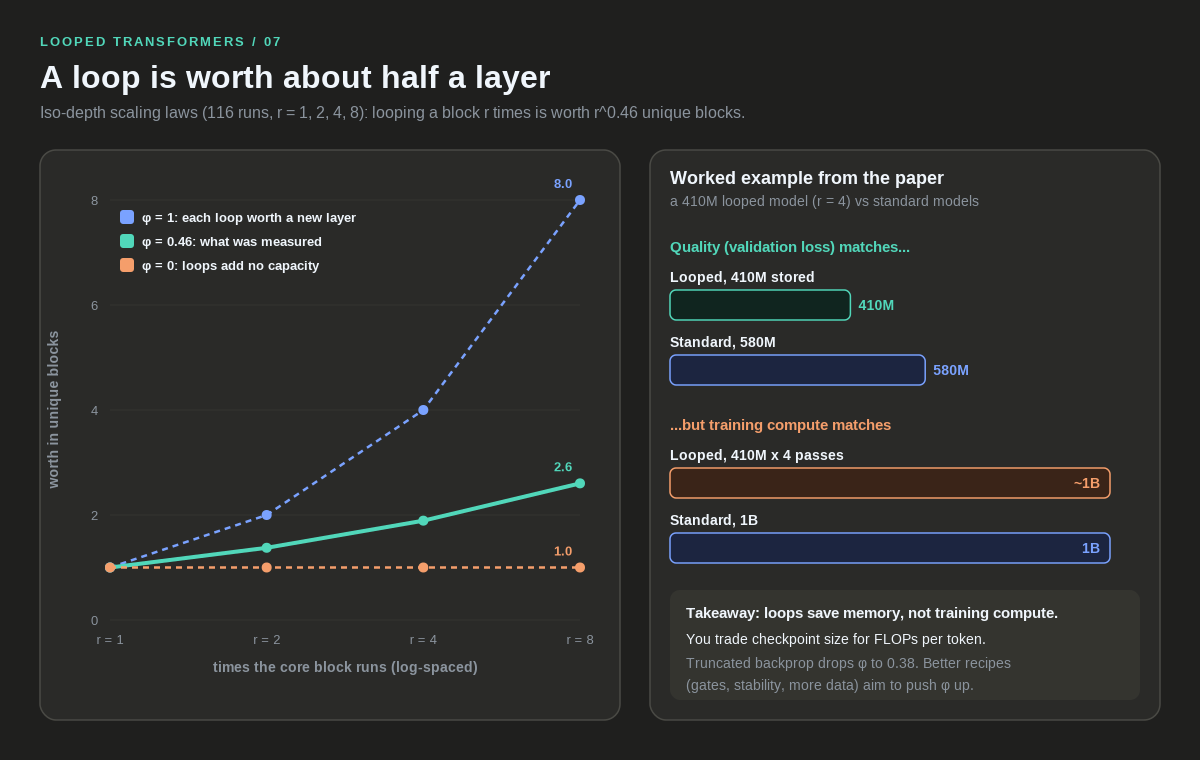
A 410M model looped 4 times matches a 580M standard model in loss, but costs as much to train as a 1B standard model.
Loops buy memory efficiency, not training efficiency. That suits laptops, edge devices and large-batch serving, and loses money when FLOPs are your constraint. Higher $r$ also wants wider models and more tokens per parameter, and truncated backprop through the loop drops $\varphi$ to 0.38. You can now score any new trick (gates, stability fixes, better data) by how far it pushes $\varphi$ above 0.46.
Training is unstable by default
Unroll a block eight times and you have a deep network with tied weights, and the residual stream tends to explode. Parcae, from UC San Diego and Together AI, treats the loop as a dynamical system and constrains the spectral norm of the input-injection parameters. That gave up to 6.3% lower validation perplexity than earlier looped recipes, and a 1.3B Parcae model matched standard transformers up to twice its size. Its scaling laws say to increase looping and data together, and test-time gains follow a saturating exponential: the first few extra passes help most, matching what Inkling and Nanbeige saw.
KV cache grows with every pass
Each pass through an attention layer produces new keys and values, so a naive implementation keeps one cache per layer per pass. Ouro 2.6B’s default code needs about 1.5 MiB of KV per token in bf16. The memory you saved by sharing weights comes back as cache.
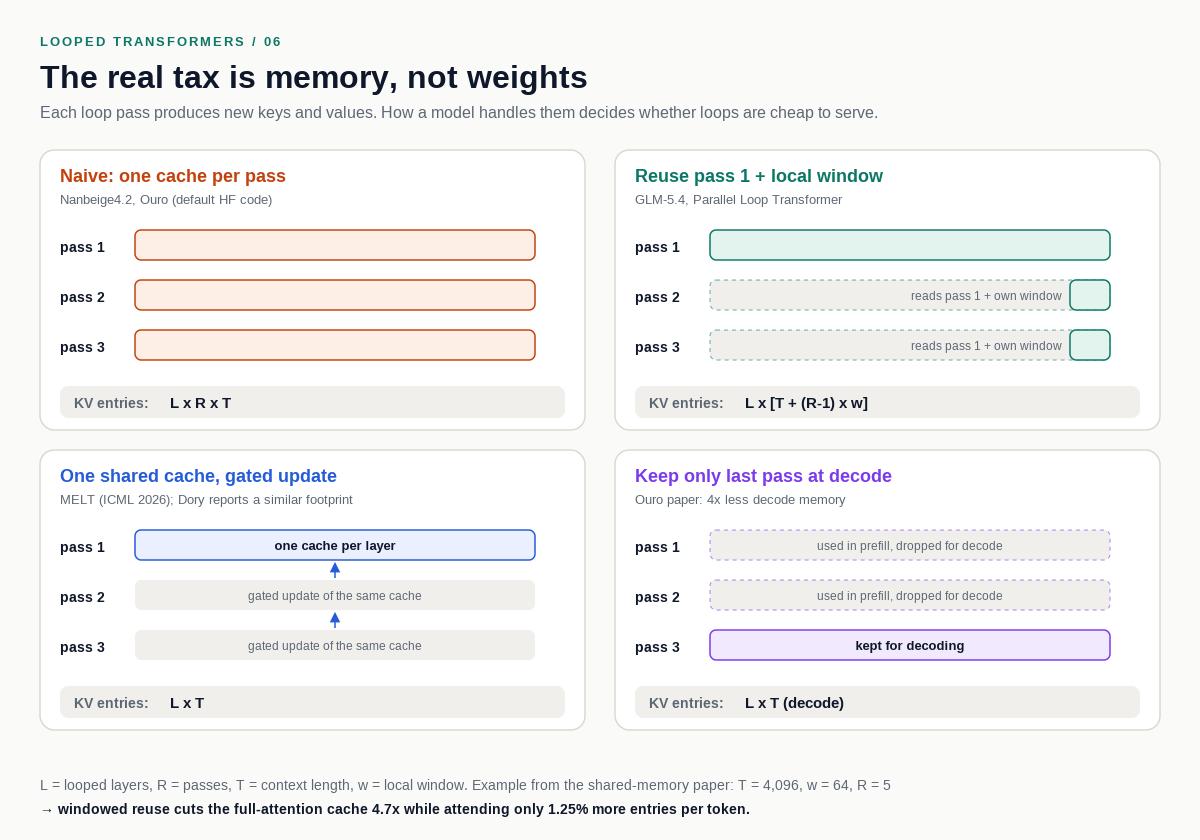
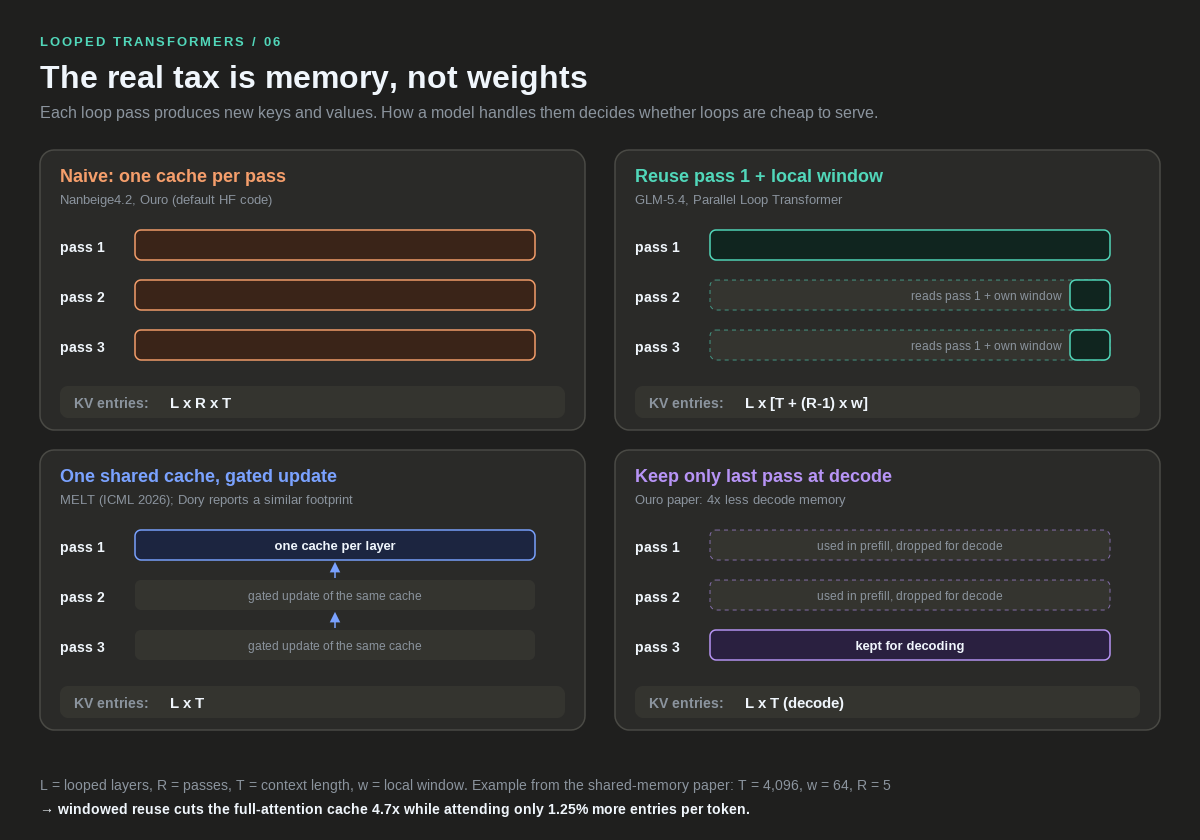
- Reuse the first pass, add a local window. Later passes read the first pass’s full cache plus their own sliding window (Parallel Loop Transformer, GLM-5.4). With $T = 4096$, a 64-token window and five passes, the full-attention cache shrinks 4.7x while each token attends only 1.25% more entries (shared-memory paper).
- One shared cache behind a gate. MELT keeps a single KV cache per layer across loops and updates it with a learnable gate, after a light post-training step.
- Keep only the last pass at decode. Ouro’s paper reports a 4x memory cut with little quality loss (not the default in its Hugging Face code).
- Training-free and linear-time variants. FlashLoop uses token-sparse updates and KV quantization across loops; LT2 mixes linear and sparse attention so looping doesn’t multiply a quadratic cost.
Latency and quantization
Looping is serial: the middle of the network runs twice before the next token can start, so time per output token rises even when total task time falls. GLM-5.4 serves up to 200 tokens/s off-peak, and Z.ai credits fused kernels for that.
Quantization errors compound across passes. A community NVFP4 build of Nanbeige 4.2 found that uniform 4-bit weights cost 8 points on GSM8K until attention and some projections stayed in FP8.
Convert or Train From Scratch?
| Camp | Who | Evidence |
|---|---|---|
| Convert a pretrained model | Z.ai (GLM-5.4), NVIDIA (Dory, loops added late), the UMD group behind Huginn | Retrofitted recurrence: initializing from Llama-3.2-1B weights beats random init per training FLOP, and converted models beat post-training the original on math |
| Train looped from the start | BOSS Zhipin (Nanbeige 4.2), ByteDance (Ouro) | Nanbeige’s report: from scratch beat upcycling at 3B and 28T tokens |
I suspect each camp is right about its own regime. If you own an expensive base model, converting a slice of it is the cheap path to more depth. If you’re training a small model on tens of trillions of tokens anyway, letting the representations grow up with the loop seems to win.
Try It Yourself
A minimal looped decoder in PyTorch
This toy has every piece from the anatomy diagram: a 2-block prelude, a 4-block shared core, a 2-block coda, input re-injection, a pass-index embedding, and a write gate that starts mostly closed. To train it so you can pick $R$ freely at inference, sample the loop count randomly each step (Huginn’s recipe).
"""
A minimal looped decoder: prelude (once) -> core (R times, shared weights) -> coda (once),
with input re-injection, a pass-index embedding and a per-token write gate.

Run: python looped_toy.py   (CPU is fine)
"""
import time

import torch
import torch.nn as nn


def block(d, heads):
    return nn.TransformerEncoderLayer(d, heads, 4 * d, dropout=0.0, batch_first=True, norm_first=True)


class LoopedDecoder(nn.Module):
    def __init__(self, vocab=32000, d=512, heads=8, n_prelude=2, n_core=4, n_coda=2,
                 max_loops=16, max_len=2048):
        super().__init__()
        self.embed = nn.Embedding(vocab, d)
        self.pos = nn.Embedding(max_len, d)
        self.prelude = nn.ModuleList([block(d, heads) for _ in range(n_prelude)])
        self.core = nn.ModuleList([block(d, heads) for _ in range(n_core)])
        self.coda = nn.ModuleList([block(d, heads) for _ in range(n_coda)])
        self.inject = nn.Linear(2 * d, d)            # mix loop state with prelude output
        self.loop_embed = nn.Embedding(max_loops, d)  # which pass the core is on
        self.gate = nn.Linear(d, 1)                   # per-token write gate
        nn.init.constant_(self.gate.bias, -2.0)       # start mostly closed
        self.norm = nn.LayerNorm(d)
        self.lm_head = nn.Linear(d, vocab, bias=False)
        self.lm_head.weight = self.embed.weight

    def run(self, layers, h, mask):
        for layer in layers:
            h = layer(h, src_mask=mask, is_causal=True)
        return h

    def forward(self, x, loops=2):
        t = x.shape[1]
        mask = nn.Transformer.generate_square_subsequent_mask(t)
        e = self.run(self.prelude, self.embed(x) + self.pos(torch.arange(t)), mask)
        h = e
        for r in range(loops):                        # same weights every pass
            u = self.inject(torch.cat([h, e], -1)) + self.loop_embed.weight[r]
            u = self.run(self.core, u, mask)
            g = torch.sigmoid(self.gate(u))
            h = h + g * (u - h)                       # gated residual write
        return self.lm_head(self.norm(self.run(self.coda, h, mask)))

    def executed_layers(self, loops):
        return len(self.prelude) + loops * len(self.core) + len(self.coda)


@torch.no_grad()
def latency_ms(model, x, loops, reps=10):
    model(x, loops)                                   # warm-up
    t0 = time.perf_counter()
    for _ in range(reps):
        model(x, loops)
    return (time.perf_counter() - t0) / reps * 1000


if __name__ == "__main__":
    torch.manual_seed(0)
    T = 256
    x = torch.randint(0, 32000, (1, T))
    model = LoopedDecoder().eval()
    params = sum(p.numel() for p in model.parameters()) / 1e6
    base = latency_ms(model, x, 1)

    print(" loops | params | executed layers | latency vs R=1 | naive KV entries")
    for r in (1, 2, 4, 8):
        n = model.executed_layers(r)
        print(f" {r:5d} | {params:5.1f}M | {n:15d} | {latency_ms(model, x, r) / base:13.2f}x | {n * T:,}")
Output on 2 CPU cores (latency ratios vary between runs):
 loops | params | executed layers | latency vs R=1 | naive KV entries
     1 |  43.2M |               8 |          1.00x | 2,048
     2 |  43.2M |              12 |          1.31x | 3,072
     4 |  43.2M |              20 |          1.97x | 5,120
     8 |  43.2M |              36 |          3.31x | 9,216
Parameters stay at 43.2M at any loop count. Executed layers and naive KV entries grow linearly with $R$. Latency grows slower than executed layers because the embedding and the 32k-vocab output head cost the same per token no matter how many loops run.
If you train this on a real multi-step task like k-hop lookup, expect the loss spikes and collapses Parcae describes. A curriculum (one step of difficulty at a time), gradient clipping and a closed-at-start gate help.
Loading a real looped checkpoint
Ouro exposes its loop count in the config:
from transformers import AutoConfig, AutoModelForCausalLM, AutoTokenizer

name = "ByteDance/Ouro-1.4B"
config = AutoConfig.from_pretrained(name, trust_remote_code=True)
config.total_ut_steps = 3          # default is 4 recurrent steps; fewer = cheaper and faster
model = AutoModelForCausalLM.from_pretrained(
    name, config=config, device_map="auto", trust_remote_code=True
)
tok = AutoTokenizer.from_pretrained(name, trust_remote_code=True)

prompt = "If a train leaves at 3:40 and the trip takes 95 minutes, it arrives at"
inputs = tok(prompt, return_tensors="pt").to(model.device)
print(tok.decode(model.generate(**inputs, max_new_tokens=20)[0], skip_special_tokens=True))
The Hugging Face version doesn’t implement Ouro’s early-exit gate yet. All configured passes run, so lowering total_ut_steps saves compute, while changing the exit threshold only picks among outputs already computed. Dory, Nanbeige 4.2, SenseNova-Loop-9B and Inkling 2 Mini are also on Hugging Face; grab Dory if you want to vary the loop count at serving time.
Closing Thoughts
A year ago, “looped transformer” meant a NeurIPS poster and a 3.5B proof of concept. Today it covers a 750B flagship, a laptop-class coding model and a rumored frontier architecture. My takeaways:
- Loop the middle. Every production model keeps a prelude and coda that run once, and Inkling’s 27-of-28 ablation backs it.
- Two or three loops, for now. Gains flatten after a few passes in Nanbeige, Inkling, Parcae and Dory. Large loop counts suit narrow, serial tasks.
- Loops save memory, not training compute. With $\varphi = 0.46$, use them when checkpoint size or memory bandwidth limits you.
- Fix the KV cache. A naive cache gives back the memory you saved on weights. First-pass reuse, shared gated caches and windowed attention make looping servable.
- Track tokens and monitorability together. Looped models write 10-60% fewer tokens for the same answer, and those missing tokens are the reasoning you can no longer read. Thinking Machines shipped a monitorability section; other labs should follow.
Next comes adaptive depth in production: models that decide per token how many passes to run. SenseTime has it on the roadmap and Ouro has it in the paper. Nobody has shipped it at scale yet.